


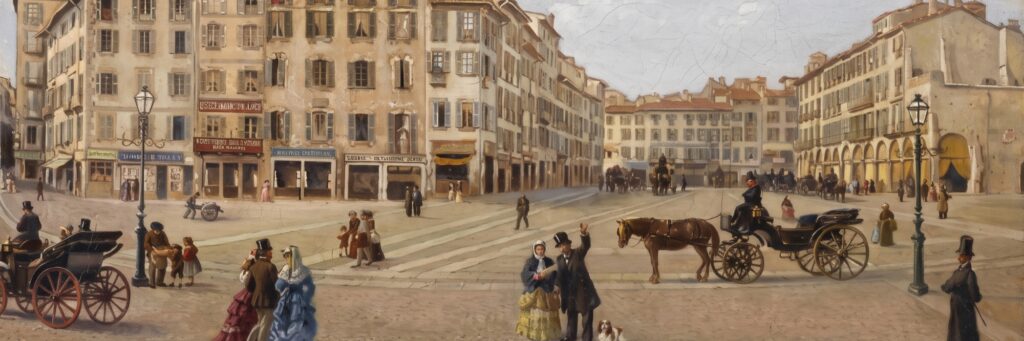
By carriage through Milan: a glossary of Milanese horse and carriage terms
“Lè ura de andà a fà ona trottada in legn”: it is time for a carriage ride. Let us travel through nineteenth-century Milan, with a glossary for lovers of horse-drawn vehicles and local dialect.
The following names and descriptions come from Francesco Cherubini’s Milanese–Italian dictionary of 1839. Dialect spellings and the author’s suggested word origins are retained as historical testimony; they should be read in the context of the period.
Carriages in the Milanese dialect
- Bagher
- A small carriage with a movable folding hood, no doors or front side panels, a body carried on springs, and two or more seats. Usually lacking a separate coachman’s box, it has four wheels and a generous turning space. Cherubini relates the name to the German Wagen.
- Barchetta
- A four-seat carriage with a concave body, doors and front side panels. Its movable apron, or scossalinna, lifts to expose the front seat and can rest against the box-seat rail as a support for passengers. The sprung body has a box-seat base, a half hood and a rear storage compartment called a borlon. Its four-wheel, perch-type undercarriage permits a half or full turn depending on whether the perch is straight or swan-necked.
- Barchettòn
- A larger version of the barchetta, with four wheels and four seats. The body has an oval or boat-shaped bottom, a half hood and an apron.
- Bastardella
- A four-wheel carriage with a square body, four fixed seats, glass windows, blinds and sunshades at the front and sides. Its fixed box-seat base and body rest on springs beneath a substantial wooden roof covered in leather. An oval-bodied version is called a Bastardella a Bombè.
- Bastardellina
- Generally similar to the bastardella but smaller, with a hinged folding seat inside the front of the body instead of a fixed two-person seat.
- Bastardellon
- A larger bastardella without front side panels.
- Batar or Batard
- Other names for the bastardella.
- Berlina
- A carriage associated by name with Berlin, similar to the caroccia de quater. Cherubini also mentions the French Allemande or berline de campagne.
- Biga
- An ancient Greek or Roman two-wheel chariot, open at the rear, with an oval standing body, no roof or seats, a short pole and a pair of horses. The Milanese term was also used loosely for four-horse and six-horse chariots. Cherubini points to the six-horse group above Milan’s Arch of Peace as a visible example, and traces the word to Latin bigae.
- Birbìn and Birbinèt
- Names referring to small versions of the carettìn.
- Birocc
- A biroccio or basket carriage, usually partly open but sometimes fitted with a small hood at the front.
- Biroccin
- A smaller version of the birocc.
- Bombè
- A four-seat covered carriage with doors and front side panels, a nearly round body on springs and a four-wheel perch-type undercarriage. The name follows French usage.
- Brancal
- A substantial two-seat travelling carriage with a long body, a heavy wooden hood, no doors or front side panels, a fixed wooden apron, two wheels and two shafts. Cherubini connects it with French brancard, describing the body as supported by long, flexible suspension straps.
- Brisca
- A four-seat carriage with doors, a half hood and a sprung body on a four-wheel perch-type undercarriage. Its floor is flat and its outside panels curve rather than stand vertically. It has the same apron and rear compartment described for the barchetta. Cherubini proposes English brisk or the northern European briwska as possible origins. A brischètta is smaller; brischettòn or briscòn are larger versions.
- Cacciadòra
- A hunting carriage, usually with a sprung body, several seats and a four-wheel undercarriage. A cacciadorina is a smaller version.
- Carrettella
- A carriage with a small two-seat body, a little door, glazed rear side panels, a front seat and a fixed wooden hood, on four wheels. The same name could also be used for a cariagginna.
- Carettìn
- Also called a birba, this was commonly a country carriage with four seats, a movable hood, doors and narrow, curved half side panels at the front. It could have a coachman’s box or box-seat base and a rear borlon compartment, with springs and four wheels. Smaller examples had also been called birbin or birbinett.
- Caretin a la franzesa
- A more refined and decorated birba, with curved front side panels that were less narrow than those of the standard version.
- Caretin a la vitura
- A less elegant birba resembling the barchetta, its body supported on the shafts and bounded by a low rail at the sides and front.
- Cariagginna
- A four-wheel vehicle carrying a long rack-like or basket-like base, on which rests an open, multi-seat body without a hood.
- Caroccetta, caroccin, caroccia
- General carriage names, also appearing as caroccia integra or caroccia de quatter.
- Carrozza or cocchio
- A four-seat carriage body with a fixed roof, doors and front side panels, supported by springs or suspension straps. The four-wheel undercarriage might be perch-type or square-framed with shafts.
- Caròccia de cort
- A court carriage and its turnout.
- Caròccia de galla
- A ceremonial carriage.
- Caroccin, carozzin, caroccetta, carrozzètta
- General terms for a small carriage.
- Càrr
- A vehicle used to carry goods. Cherubini lists rural carr, barozza and volantin; military carriag and forgon; workmen’s carretta, carrettin and carretton; and merchants’ carrettella, carriagginna, bara and basterna. He distinguishes the wide-bed, four-wheel carr, with a turning forecarriage, from the narrow-bed, two-wheel barozza, whose pole runs the length of the vehicle and is called a forca.
- Carocciòn or carozzòn
- A large coach; in postal use, especially the large carriage serving as a velocifero.
- Carrociòn del peccàa
- A term listed without an accompanying definition in this extract.
- Cittadina
- A two-seat carriage with a flat-bottomed body, fixed hood, doors and a box seat attached to the body. It has no front side panels, but has front and side mudguards, springs, four wheels and generous turning clearance.
- Còmod
- An everyday name for a usable covered carriage with four seats and four wheels.
- Coppè or cuppè
- A carriage with a fixed roof and doors, no front side panels, springs and four wheels. Cherubini compares it with the French berlingot or berline coupée, from which the local word was derived.
- Corèra or legn a la corèra
- A courier’s vehicle.
- Diligènza
- A large stagecoach carrying numbered passengers, goods and money between fixed destinations on a timetable. Its substantial body has a fixed roof, often several doors, springs and suspension straps, and a straight-perch four-wheel undercarriage. The driver’s box has several seats beneath a fixed hood; some coaches also have the rear extension called a baltreschin.
- Dormoeùs
- A two-seat travelling carriage with a rounded, fixed-roof body, doors and a long storage box that can be opened to allow passengers to stretch out their legs and sleep. It has springs and four wheels. The word comes from French dormeuse.
- Faetòn, faitòn or favetòn
- A phaeton: in the description, a light, open two-wheel carriage with wheels set away from the body, a fixed mudguard and a movable hood, resembling a dress cabriolet. Cherubini links the name to the myth of Phaethon driving the Sun’s horses, mentions Salvini’s translation of the Odyssey, and cites an English phaeton illustrated in Corriere delle Dame on 8 June 1820. He notes that the term was also being applied to four-wheel vehicles with two or more seating compartments and sometimes a coachman’s box.
- Faetonìn or faitonin
- A smaller phaeton.
- Fiaccher or fiàcca
- A numbered public hire carriage, known to the police and waiting in city squares to leave on demand. The name came with the custom from French fiacre. Cherubini records competing explanations for the word, including the Saint-Fiacre association in Paris. Used carriages of different forms could serve, provided they had four wheels, four seats and a cover when needed.
- Fiaccherìsta, fiaccarìsta or fiaccarèe
- The driver of a fiacre.
- Furlòn
- An enclosed coach resembling a landau but with unequal seats. Cherubini tentatively relates the name to Spanish forlón or furlón, noting that the term was already falling out of local use.
- Gabriolè
- A neat two-seat cabriolet with a boat-shaped body, hood, springs, two wheels and shafts, but no doors or front side panels; from French cabriolet. The word could also refer to the covered, multi-seat driver’s position taking the place of a box seat on stagecoaches and travelling coaches.
- Garì
- A small carriage with a body.
- Garricch
- A light, elegant open two-seat vehicle with exterior cane-work panels, no doors or front side panels, a sprung body, fixed mudguard and two wheels. Cherubini gives an English connection for the name.
- Ghìcch
- A hunting gig similar to the garricch but less decorated. Cherubini relates the name to French guigue or guingue and mentions a Dumont-style example illustrated in Corriere delle Dame on 12 April 1828.
- Landò
- A landau with four wheels, a sprung boat-shaped body, four seats, doors and front side panels. Equal facing seats sit beneath a roof that can divide and fold away when passengers wish to travel in the open. Cherubini discusses possible French, English and German origins for the name.
- Landolètt or mezzlandò
- A small landau, generally with two seats, no front side panels and sometimes a little additional seat in front.
- Legn de caccia
- A hunting vehicle, also used for a particular four-wheel carriage with a sprung body and a somewhat concave underside to provide turning clearance.
- Legn de posta
- A post chaise, or more generally a carriage kept by posting-house operators for travellers who had no vehicle of their own.
- Legnett
- A general name for small carriages and chaises.
- Legn-scalfaa
- A two-seat four-wheel carriage without a perch or shafts, its body supported on five or more springs arranged in different directions. It has side and front mudguards, no doors, a fixed box-seat base and a removable box seat. Cherubini compares it with an English phaeton whose recessed body allows the springs and turning gear to move freely.
- Mezza-caròccia
- A general name for vehicles fitted with a timonella, a light crossbar-and-shaft arrangement.
- Mùda
- A turnout: muta a quattro or muta a sei can mean a carriage drawn by four or six horses, or the team of horses itself.
- Nibbi
- A humorous name for an ungainly or mixed-form small carriage, especially a tilbury or similar vehicle.
- Omnibus
- A large, multi-seat four-wheel coach with a fixed-roof body, doors, front side panels and springs. Additional passengers could sit on seats on the roof.
- Padovanèll
- A small, elegant one-seat two-wheel vehicle with an open body shaped somewhat like half an eggshell or shell, no doors, and support directly on the shafts. Cherubini notes the French use of the Italian term un solo and suggests a connection with the vehicle’s popularity around Padua. It was sometimes loosely called a sediolitt.
- Polonèsa
- A Polish-style carriage with a boat-shaped, sometimes fluted body, hood, springs and two seats, plus seating for a driver and servants. It has no doors or front side panels and uses a four-wheel perch-type undercarriage.
- Polonèssina
- A smaller version of the polonèsa.
- Rococò
- Described as newly fashionable in Cherubini’s time: a bastardella-type four-wheel carriage without a perch or shafts, its body resting on springs. Very low doors and side mudguards form steps almost at ground level. The author compares it with early carriages formerly called carrette.
- Rompacòil
- An English-style two-wheel carriage with a yoke, C-shaped rear side panels, springs and straps, two seats, a movable hood and a fixed mudguard. It has neither doors nor front side panels; its pole, supported over the horses by a yoke, takes the place of the usual shafts and perch.
- Sciarabàn
- A charabanc with a rounded, fluted body that can be open or covered, springs and two seats. It has no doors or front side panels, sometimes includes a driver’s seat, and runs on four wheels with a light shaft arrangement. From French char-à-bancs.
- Sciarabanèll
- A similar small carriage.
- Sciarabanin
- A smaller charabanc.
- Sciaracotè
- A four-wheel vehicle with a straight perch, an ordinarily open body and flexible wooden supports. A long central bench carries several passengers, and the body can be turned so they face the view on either side. Cherubini associates it with Swiss mountain and lakeside travel and derives the name from French char à côtés.
- Sedia
- An open, rather substantial two-seat chaise supported on two long shafts resting over a horse. It has two wheels and no doors.
- Sedioeù
- A smaller one-seat chaise. Some examples had a seat that could expand sideways to squeeze in two people, earning an informal dialect nickname for “one and a half seats”.
- Sediolin
- A still smaller version; the name was also sometimes used for the padovanèll.
- Sgoràtta
- A chaise with two wing-like extensions parallel to the top edges of its body. Cherubini connects the name with the dialect verb meaning “to fly”; it resembles the sedia but is lighter throughout.
- Staìbagher or stirvàgen
- A four-wheel carriage with a long, fluted, sprung body, a hood, two seats and doors. A large leather-covered wooden luggage compartment rises at the rear where servants might otherwise stand. Cherubini records several possible German word connections.
- Stanòpp
- A light vehicle with a high, open body and a fixed mudguard, named after the English Stanhope.
- Stracàn
- A carriage name whose origin Cherubini explicitly leaves uncertain, suggesting either Astrakhan and a Russian style or the British admiral Strachan.
- Svìmer
- Another carriage name for which the dictionary proposes connections with German Schwimmer or an English word associated with floating or turning.
- Tilber
- A tilbury: usually an open, square-bodied two-seat chaise without doors or front side panels, with a fixed front mudguard and springs. Its two-wheel undercarriage has long, open elliptical shafts. Cherubini suggests an English origin for the name.
- Timonèlla
- A relatively small vehicle that uses a light crossbar and short shafts with one horse where the larger form would have a pole and two horses. Such vehicles were also informally called mezza caroccia.
- Vagòn
- A railway carriage, then newly fashionable in the account, with a long, flat, sprung body, several doors, internal partitions and six or eight wheels. Some versions also carried roof seats, like an omnibus. The name came from English waggon.
- Velozifer
- A large coach with seats around an ordinarily square body, a substantial fixed roof, springs and a four-wheel wooden-perch undercarriage. It often had a rear extension called a baltreschin, fitted with windows, a door and two or more seats.
- Viccìura or vittùra
- The same vehicle as a legn a la vitura.
- Visavi
- A narrow berlin-style carriage with just two seats facing each other; from French vis-à-vis, meaning face to face.
- Vòrst or vùrst
- A four-wheel carriage with a rounded body, a two-seat rear bench and a lengthwise central seat on which passengers sit astride. Usually without doors, it has a leather apron, commonly a hood and springs, and large side mudguards protecting passengers from spray from the rear wheels. Cherubini notes related French and German names, including Wurst.
Other names in a changing city
Cherubini also mentions vehicles such as the Russian droschki, Parisian three-wheel tricycle or delta, and the light, high-bodied English whisky. He explains that he does not describe them individually because, unlike the preceding names, they had not entered everyone’s everyday vocabulary.
The glossary preserves more than carriage designs: it records how a city named the vehicles, trades and journeys that shaped its streets.
Categories
Recent Posts
All the articles

Alberta’s rodeo and cowboy culture: a journey from Wild Horse Races to the everyday life of working ranches.

From the Steel Pier’s diving horse acts to Sonora Carver: an unusual and controversial chapter in equestrian entertainment.

The Japanese mare who ran 113 races without a victory and won the public’s affection beyond the finishing order.