The neck rope, a simple rope placed around a horse’s neck, has become one of the best-known pieces of equipment associated with natural horsemanship. It is often linked to the Parelli approach and the search for more subtle communication between horse and rider.
Yet guiding a horse without a bit and with a simple neck collar is not a modern idea. Historical precedents take us back more than two thousand years to the riders of Numidia in North Africa.
The Numidian collar: riding without a bit in antiquity
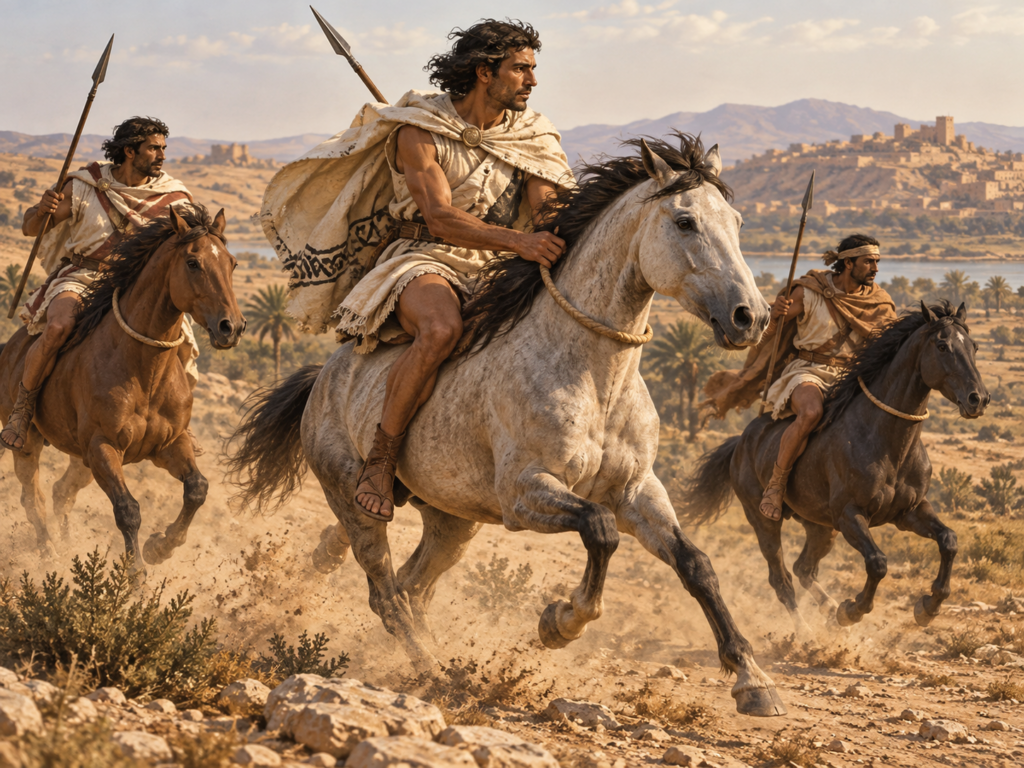
The Numidians, who lived mainly in what is now eastern Algeria and Tunisia, were famous in the ancient world for their riding skills.
Historical accounts describe them riding without saddles or conventional bridles, relying largely on their legs, voice and a simple rope or collar around the horse’s neck.
Strabo described riders guiding their horses with a rope rather than a bit, noting that the animals were spirited yet manageable.
This ancient equipment is now often referred to as the Numidian collar.
Evidence in Roman mosaics
The evidence is not limited to written accounts. Several Roman mosaics show horses wearing a collar at the base of the neck. Examples discussed in the source material include mosaics from Oudna, El Djem and Althiburus, mainly dating from the third and fourth centuries AD.
Some images show a collar and a bit together, suggesting a period in which different equestrian traditions could coexist.
These depictions make comparisons with equipment used in modern natural horsemanship particularly interesting.
From ancient riders to the modern neck rope
The principle behind today’s horse neck rope is to reduce reliance on the reins gradually and make greater use of the seat, legs, pressure and release, and body language.
This approach has helped make the rope popular in natural horsemanship.
Pat Parelli’s method contributed to the popularity of this work through groundwork, progressive communication and riding with increasingly simple equipment.
The underlying concept nevertheless has much older precedents.
The study of the Numidian collar even describes an ancient image of a rider using a small flexible rod alongside the collar, which the author compares with modern tools such as the Carrot Stick.
What about Indigenous American riding cultures?
The equestrian cultures of Indigenous American peoples are also often associated with riding using relatively simple equipment.
Following the introduction of horses to the Americas, different communities developed sophisticated handling and riding practices, in many cases using ropes, rawhide and simple tack rather than elaborate European bridles.
It is important not to oversimplify this history: there is no documented direct line connecting the Numidian collar, Indigenous American peoples and the modern Parelli neck rope.
Instead, we can speak of similar solutions developed in different periods and cultures, sharing a search for more direct communication with the horse.
A neck rope is more than a simple rope
Today, a neck rope is mainly a communication tool and a way of assessing the understanding developed between horse and rider.
It does not simply mean removing the bridle. Working with a collar requires preparation, a gradual approach and a horse trained to respond to the rider’s body aids.
Its simplicity is perhaps part of its appeal.
An equestrian history spanning more than two thousand years
Seeing a horse ridden with only a neck rope might suggest an innovation introduced by modern natural horsemanship. History offers a wider perspective.
Numidian riders in antiquity already rode without bits using simple systems of communication. Comparable techniques appear, with different characteristics, in numerous equestrian cultures.
The modern neck rope can therefore be seen as a new interpretation of a much older principle: seeking cooperation through lighter signals, until equipment becomes almost secondary.