In the far west of Mongolia, between the Altai Mountains and the borders with Russia and China, lies a region quite different from the country’s most familiar image: Bayan-Ölgii.
Here, Mongolian and Kazakh cultures meet, and the horse remains central to everyday life, traditions and major community celebrations.
Bayan-Ölgii is the heart of Mongolia’s Kazakh community and a place to encounter an equestrian culture closely connected to its roots. Some tourism sources put the ethnic Kazakh population at around 90%, although figures vary by year and source.
A different side of Mongolia
Ölgii is the provincial capital, while places such as Sagsai and Bugat are important centres of Kazakh nomadic culture.
Families here maintain close relationships with livestock, horses and the mountains, keeping traditions alive across generations. Sagsai is particularly known for eagle-hunting families and festivals that attract visitors from around the world.
The horse is more than a means of transport: it remains a central part of local identity.
Kazakh hunters and golden eagles
Bayan-Ölgii is especially famous for its Kazakh golden eagle hunters, often called berkutchi.
At festivals, riders wear traditional clothing and carry an eagle on their arm, taking part in trials that assess the relationship between handler and bird.
The eagles are called from a distance, flying from elevated positions towards their handler or towards lures drawn by a rider. Alongside the competition, these gatherings help preserve and pass on Kazakh culture to younger generations.
The eagles, however, are not the only participants.
Kokpar: a test of strength on horseback
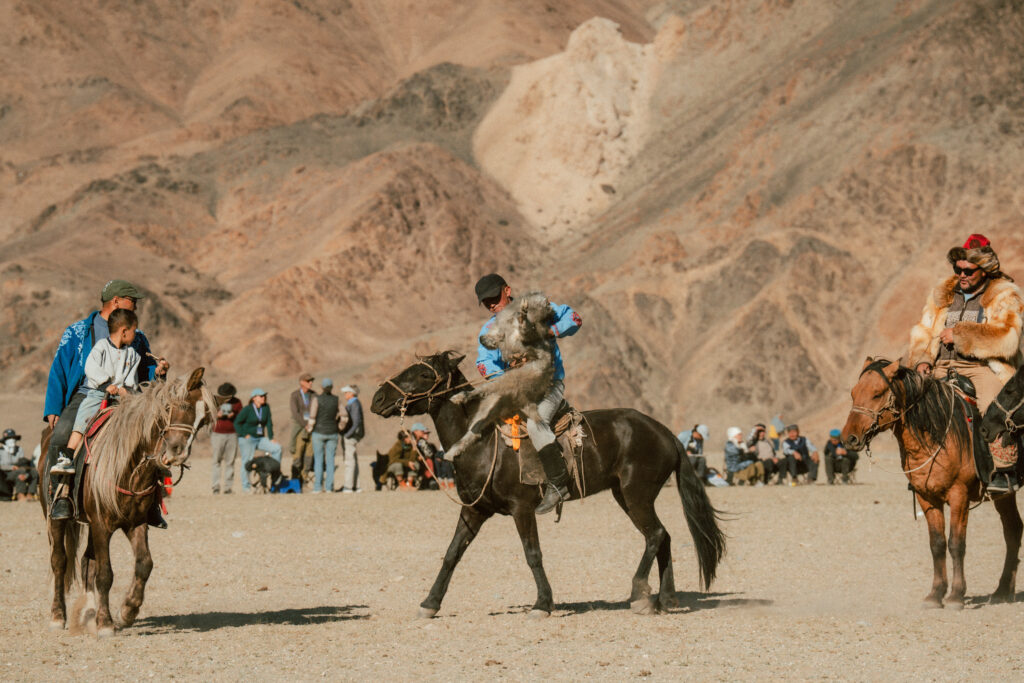
Among the most striking festival events is Kokpar, an ancient equestrian game practised in Central Asian cultures.
Traditionally, two or more riders compete for a goat carcass or skin, trying to gain possession and carry it to an agreed point.
It is a demanding contest. Lifting the weight from the ground calls for physical strength; controlling the horse one-handed requires balance; and resisting other riders demands considerable equestrian skill.
At some Eagle Festivals in Mongolia, adapted versions use a skin or leather sack. Official Mongolian descriptions include the game among traditional Kazakh activities alongside other equestrian contests.
The Kokpar horse
Speed alone is not enough in Kokpar. The horse must be bold, agile, quick to change direction and responsive among other horses.
Riders often lean far down the side of their mount to collect the goat or skin from the ground while maintaining balance and direction.
This reveals a distinctive feature of Kazakh riding culture: a familiarity between horse and rider built from childhood. For many participants, the activity continues a life already spent on horseback rather than a sport first learned as an adult.
From everyday work to celebration
To understand these competitions, remember that riding in the wide spaces of the Altai developed first from necessity.
For centuries, horses were essential for travel, managing herds, hunting and keeping distant communities connected.
Today’s festivals turn these practical abilities into spectacle and competition. Eagle hunting, Kokpar and other equestrian trials become a living account of Kazakh nomadic history.
A journey into the equestrian heart of the Altai
Visiting Bayan-Ölgii during an Eagle Festival offers more than watching a competition. It provides an encounter with a culture in which horses, the land and tradition remain closely intertwined.
Galloping riders, golden eagles descending from the mountains and Kokpar players competing in the dust can evoke another era.
Yet this is not a historical reconstruction. In Bayan-Ölgii, this culture is still alive.