When we think of Italy’s Highway Code, we usually picture cars, motorcycles, traffic lights and motorways. Yet its rules still cover one of the oldest forms of transport: the horse.
Riding and pack animals, along with animal-drawn vehicles, remain part of Italian road traffic legislation. The relationship between horses and road rules, however, began long before the motor car.
Early traffic rules in ancient Rome
Traffic was already a challenge in Roman times. The major consular roads formed an important network for military, commercial and civilian travel, while cart traffic inside Rome could become chaotic.
In Claudio Barsuglia’s account, one significant early form of regulation was the Lex Iulia Municipalis, associated with Julius Caesar’s period and described as a distant predecessor of modern road legislation.
Rules controlled carts’ access to the city, restricting heavy traffic from dawn into the afternoon, with exceptions for public services and essential urban needs. It was, in effect, an early form of a restricted traffic area.
When horses were a principal means of transport
For centuries, horses were central to human mobility. They made long-distance journeys possible, transported goods, connected distant territories and played a major role in military activity.
The horse was, in practical terms, a form of transport.
Like motor traffic today, horses and carts could also create hazards. Excessive speed, careless handling and increasing congestion called for more precise rules.
From the nineteenth century to the motor car
More modern traffic regulations began to appear in the nineteenth century. Barsuglia’s account recalls provisions introduced in 1865 concerning speed and the conduct of drivers of animal-drawn vehicles.
A few decades later, the arrival of the motor car transformed travel.
In 1901, Italy issued regulations for motor vehicles on ordinary roads, as the horse gradually began to lose its central place in everyday transport.
Mechanisation did not, however, remove horses from the roads altogether.
Horses remain part of Italy’s Highway Code
From the early twentieth-century codes to current Italian legislation, the movement of animals and animal-drawn vehicles has continued to be regulated.
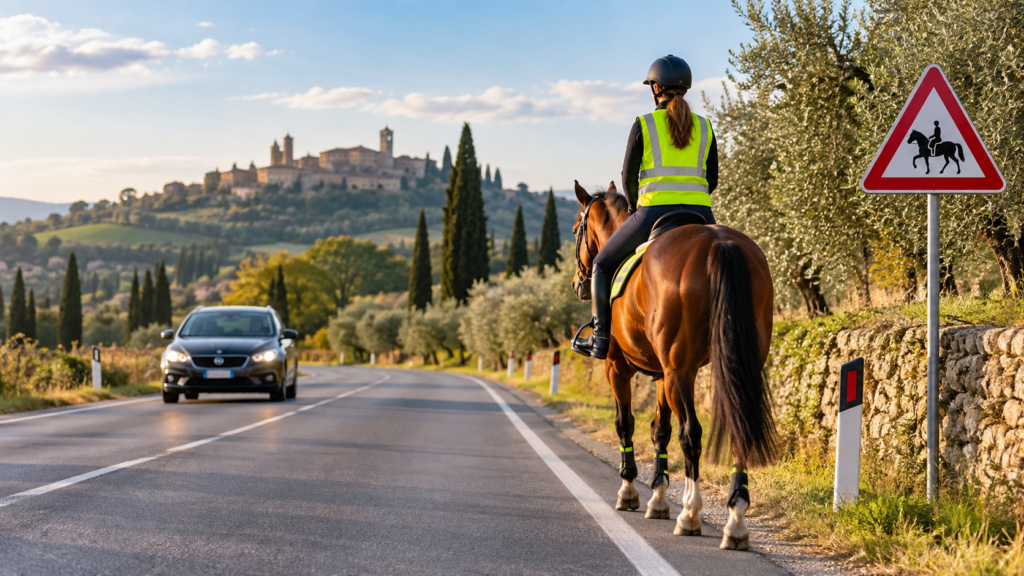
A rider using a public road therefore becomes part of road traffic and must understand and follow the applicable rules.
This applies to people handling riding, pack or draught animals, as well as those driving horse-drawn vehicles. Barsuglia notes that these provisions are not always well known among riders, even though they involve responsibilities and rights.
Horses on roads: a matter of safety
Horses are less common on roads than a century ago, but encounters still occur in rural areas, on riding routes and where trails meet or connect.
Sharing the road therefore requires care from both drivers and riders.
A horse is a living animal and may react unexpectedly to noise, horns, motorcycles or vehicles passing too closely.
Riders, meanwhile, need to recognise that they are sharing an environment with other road users and act prudently.
From Roman carts to riding holidays
Vehicles, towns and roads have changed, yet some of the challenges remain familiar.
Two thousand years ago, authorities sought to manage cart traffic in Rome. Today, horses account for a small share of road use but retain a place within Italian road legislation.
For people taking part in trail riding, equestrian tourism or rides involving public roads, understanding the applicable rules helps them travel safely and consider other users.
Even in the age of the motor car, the horse still has a place on the road. This article concerns the Italian context; riders travelling elsewhere should check the rules applying to their route and destination.