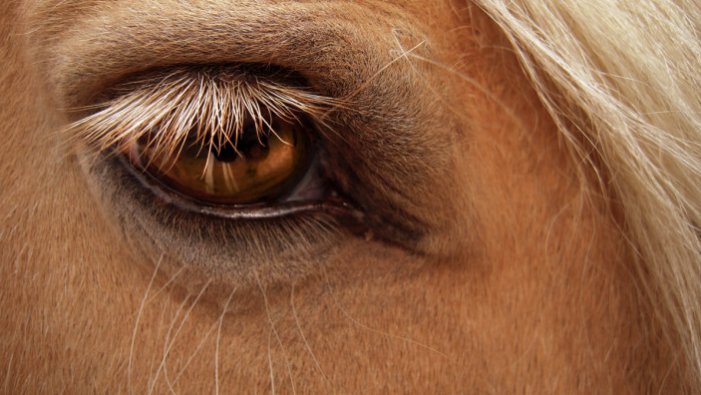
Chi vive il cavallo ogni giorno lo sa: il suo sguardo è qualcosa di profondo, quasi magnetico. Non è solo uno strumento di percezione, ma una vera porta sul mondo interiore dell’animale.
We all know that a horse has a field of vision of around 300°, with two small blind spots (one at the front and one at the back). But behind these extraordinary eyes lie even more fascinating characteristics.
Let’s find out together…
- Non tutti gli occhi dei cavalli sono marroni
When we think of horses’ eyes, we immediately picture the classic deep, glossy dark brown. In reality, nature offers much greater variety.
Oltre al marrone, esistono:
- blue eyes (often called ‘gazzuoli’)
- extremely rare instances of green hues or distinctive highlights
- coat colour combinations, such as those found in piebald horses
Eye colour is not just a matter of appearance: it is often linked to genetics and can also affect sensitivity to light.
- A “smart” focus on survival
A horse’s eye works very differently from ours.
- The upper part of the eye is specialised for seeing distant objects
- The lower section focuses on the nearby area
This means that the horse can graze on the grass whilst keeping an eye on the horizon
A perfect system for a prey animal.
That’s why we often see them nodding their heads up and down: it’s not random, but a way of focusing precisely on their surroundings.
- Two pairs of eyes, two interpretations
One little-known fact concerns the way in which a horse’s brain processes images.
Information from the right and left eyes is processed slightly differently. This can lead to a curious situation: an object seen with one eye may appear ‘new’ or suspicious when viewed with the other
That is why, during training, it is important to accustom the horse to both sides. It is not just a matter of discipline, but of neurological perception.
- A strikingly twilight-like vision
Horses can see better than us in low light: about 50% better.
This makes them particularly active and confident at dawn, at dusk and in dimly lit environments. As for colours, they perceive green and blue clearly, whilst other colours appear more muted, resembling shades of grey
- A natural “protective system”
There is a truly fascinating anatomical feature: above the eye, in the temple area, there is a slight indentation.
This structure allows the eye to: recede slightly in the event of an impact, a sort of natural defence mechanism that helps to protect an extremely delicate area – yet another example of how the horse’s body is designed for survival.
A gaze that goes beyond sight
A horse’s eye is not merely a sensory organ. It is communication, connection and emotion.
Anyone who has ever made deep eye contact with a horse knows this:
in that gaze there is attentiveness, presence… something that is hard to put into words.
Perhaps that is precisely the secret:
they don’t just look at the world. In some way, they also look inside us.