Exploring Sardinia on horseback means entering a distinctive natural landscape of basalt plateaux, cork oak woods and scenery that seems almost unchanged by time. For riding enthusiasts, crossing the Giara di Gesturi plateau is one of the island’s most captivating experiences.
This is where one of Italy’s oldest and most fascinating horse breeds lives in the wild: the Cavallino della Giara, a small wild horse that symbolises Sardinian biodiversity.
Observing these horses in their natural surroundings is a memorable experience for lovers of nature, hiking and equestrian travel.
The Cavallino della Giara: a unique breed of horse from Sardinia
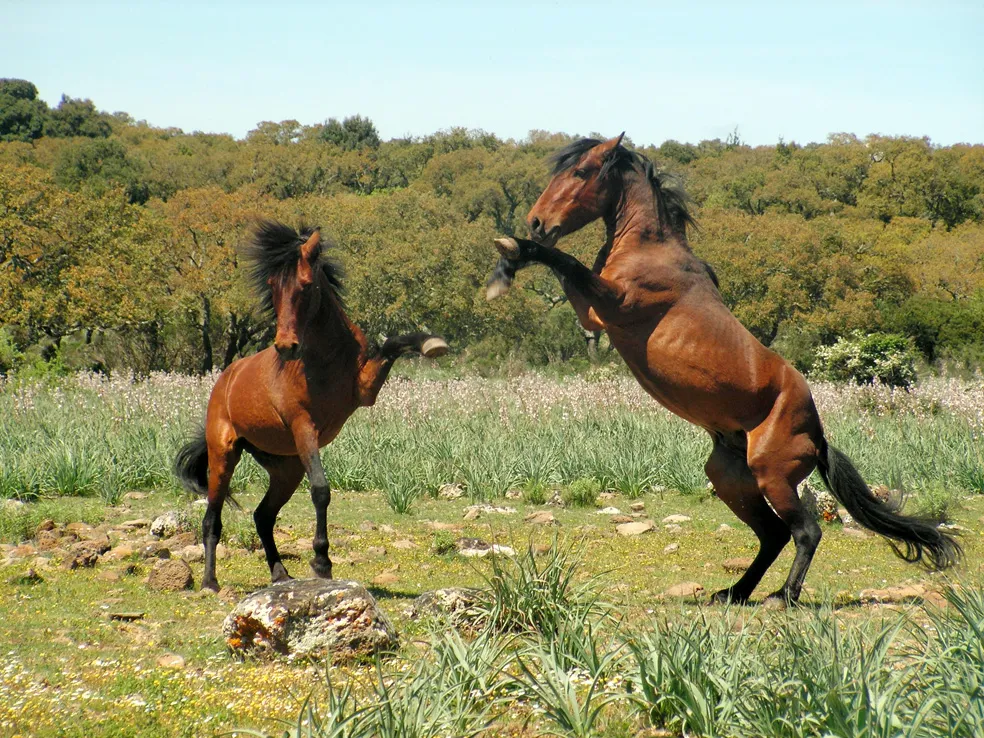
The Giara horse (also known in Sardinian as acheta, akkètta or cuaddeddu) is a breed native to Sardinia that lives in the wild on the Giara plateau.
This is a population of horses that has remained isolated for centuries due to the natural topography of the area. The plateau, situated at an altitude of between 500 and 600 metres, is surrounded by steep basalt cliffs which have limited contact with other horses, thereby preserving the breed’s original characteristics.
Today the herds still live free-ranging, well adapted to this wild, biodiverse environment.
Ancient origins, blending history and legend
The origins of the Cavallino della Giara are still not entirely clear and continue to fascinate scholars and enthusiasts alike.
One theory suggests that the horses descend from North African animals introduced to Sardinia by Phoenicians or Greeks in the fifth or fourth century BC.
Another theory, however, suggests that horses were already present in Sardinia long before that and had been domesticated by the Nuragic peoples. In this case, the Cavallino della Giara could be a direct descendant of the wild horse that was present on the island as early as the Neolithic period, as suggested by certain fossil finds dating from around 6000 BC.
Over the centuries, these small horses were widespread across much of Sardinia. It was only from the late Middle Ages onwards that their population gradually became concentrated on the Giara plateau.
Characteristics of the Giara pony
The Cavallino della Giara is a small but very hardy horse, perfectly adapted to the environmental conditions of the plateau.
Its main features are:
- Height at the withers: approx. 120 cm
- Coat: generally wild bay, black or dark chestnut
- Head: robust and fairly square
- Man: thick, with a very prominent tuft
- Neck: short and muscular
- Withers: not very prominent
- Croup: short and sloping, with a low tail set
- Eyes: slightly almond-shaped
- Limbs: slender yet strong
Despite its small stature, it is not classified as a pony but as a small horse.
Un carattere selvatico e indomito
One of the most fascinating characteristics of the Cavallino della Giara is its free-spirited and independent nature.
Having lived in the wild for centuries, these horses retain a lively, wary and often restless temperament. The herds roam freely across the plateau in search of water and pasture, adapting to a natural environment that can be harsh and unforgiving.
It is precisely this wild nature that contributes to the fascination these animals hold for those who observe them.
A symbol of Sardinian biodiversity
Today, the Giara pony is one of the most important symbols of Sardinia’s wildlife and equestrian tradition.
Visitors to the Giara plateau can experience an extraordinary landscape on foot or on horseback, encountering free-ranging herds moving among woodland, meadows and small seasonal pools.
An encounter that serves as a reminder of how deeply rooted the relationship between horses, nature and the local landscape still is in some of Italy’s most unspoilt areas.