If you grew up surrounded by stables, stirrups and sand arenas, the idea of riding without a real horse probably sounds… bizarre, to say the least. And yet there is a structured discipline, complete with rules, official competitions and top-level athletes: it’s called hobby horse.
No, it’s not child’s play. Or rather: it’s not only
What is hobby horse?
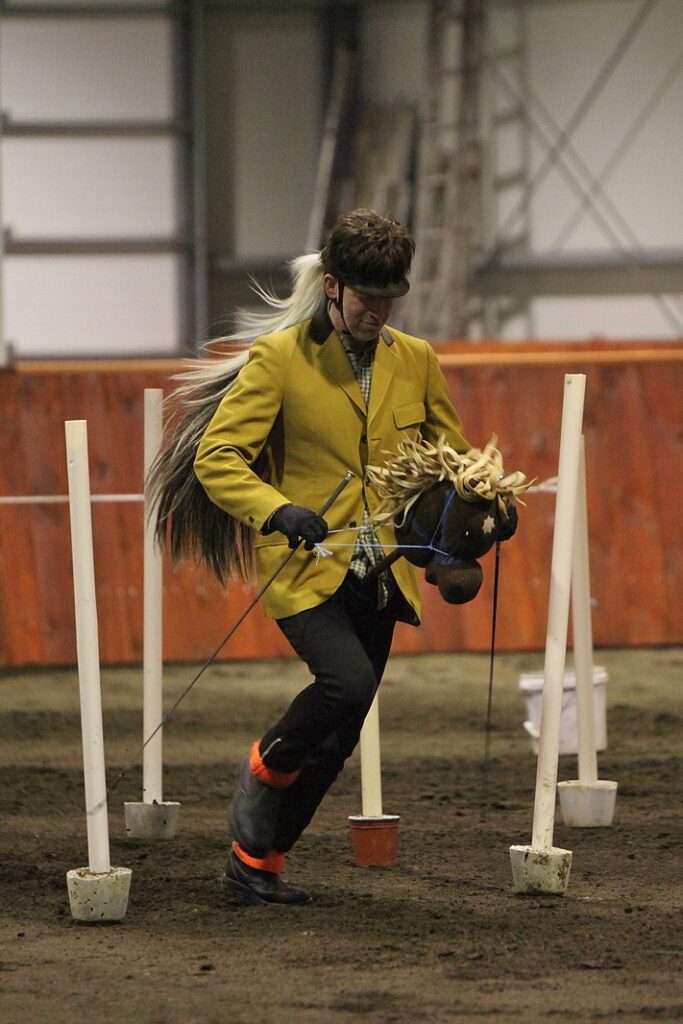
The hobby horse began as a symbolic toy, but in recent years – particularly in countries in Northern Europe – it has become a fully-fledged sport. Athletes ride an ‘imaginary’ horse, represented by a horse’s head mounted on a pole, and compete in events such as show jumping,< 5 >dressage< 6 >and even< 7 >cross-country. There’s no horse, but the physical exertion is very much there. And how.
Technique, preparation and… stamina
Those familiar with traditional horse riding will immediately recognise some familiar elements: posture, balance, precision of movements, rhythm, and memory of the course. In show jumping, the jumps can exceed one metre in height – and yes, they are cleared using one’s own legs. It requires strength, coordination, flexibility and a considerable level of physical fitness. In dressage, on the other hand, the quality of the movements, the fluidity of the movements and the ability to ‘interpret’ the horse are judged. It is an exercise that requires concentration and great body control.
The imaginary horse… well, not quite
One of the most striking aspects for an observer is the relationship between the athlete and the hobby horse. Each horse has a name, a personality and a ‘story’. It is cared for, customised, carried from place to place and treated with a respect surprisingly similar to that shown towards a real horse. For people who see riding as a relationship as well as a sport, this may be the easiest aspect to understand.
Why does it also interest riders of real horses?
Many riders view the hobby horse with scepticism, others with a touch of irony. But there are also those who are beginning to see it as a complementary tool: ground work, route memorisation, coordination, or simply a way to continue ‘experiencing the horse’ when they cannot ride.
And then there’s a key point: it’s inclusive. There are no financial constraints associated with keeping a horse, no risk to the animal, and it’s accessible to anyone with a passion for the sport and a desire to get active.
A strange but interesting future
Hobby horsing divides opinion, brings a smile to people’s faces, and sometimes sparks debate. But like many disciplines that originated on the fringes, it is finding its own identity. And perhaps it reminds us of something that horse lovers should know all too well: riding is not just about ‘mounting’ a horse, but about imagining, feeling and interpreting.
Even when the horse exists in our imagination.